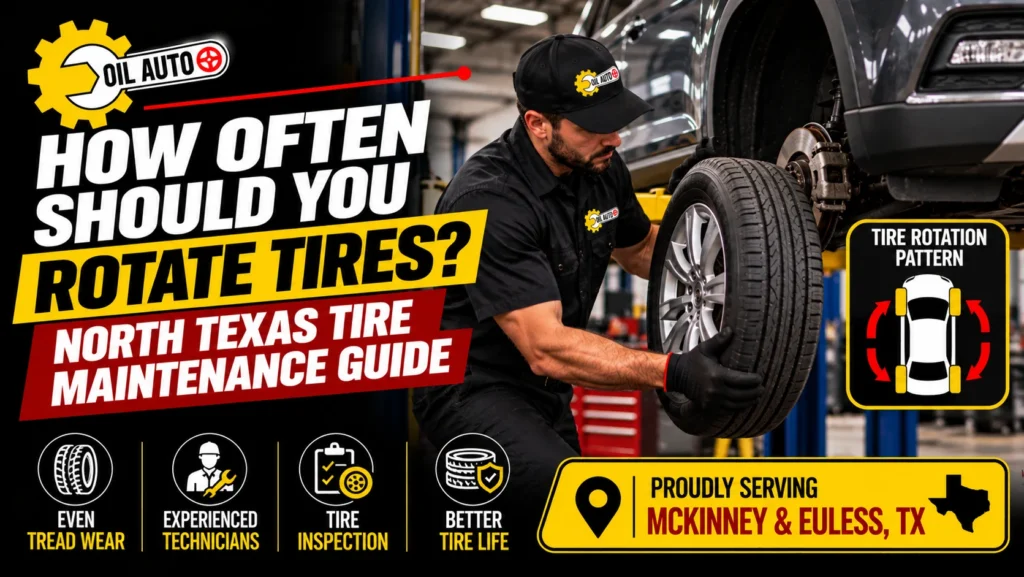
How Often Should North Texas Drivers Rotate Their Tires?
Your vehicle’s tires play a major role in handling, braking, traction, and overall driving safety. However, many drivers focus on checking tire pressure and replacing worn tires while overlooking another important maintenance service: tire rotation.
If you drive regularly around McKinney, Euless, or other parts of North Texas, your tires experience different levels of wear depending on traffic, road conditions, driving habits, and vehicle design. Without regular rotation, some tires may wear out much faster than others, potentially leading to premature replacement.
So, how often should tires be rotated? Most vehicles benefit from a rotation every 5,000 to 7,500 miles, although the manufacturer’s recommended schedule should always take priority.
Understanding your tire rotation schedule, recognizing uneven wear, and keeping up with routine inspections can help extend tire life and maintain reliable handling throughout the year.
How Often Should You Rotate Tires?
For most passenger vehicles, a practical guideline is to schedule tire rotation every 5,000 to 7,500 miles, or approximately every six months, depending on your driving habits and manufacturer’s recommendations.
Your vehicle owner’s manual should always be your primary reference because different vehicles and tire configurations have different requirements.
Here is a general guideline to help you plan your tire rotation mileage:
| Driving Situation | Suggested Rotation Interval |
|---|---|
| Normal daily commuting | Every 5,000–7,500 miles |
| Frequent highway driving | Follow manufacturer schedule, typically 5,000–7,500 miles |
| Stop-and-go city driving | Around every 5,000 miles |
| Heavy loads or towing | Follow a potentially shorter manufacturer-recommended interval |
| Performance vehicles | Follow the tire and vehicle manufacturer’s specific schedule |
Some manufacturers recommend rotation at every scheduled oil change, making it easier to remember both maintenance services together.
Do not wait until your tires look visibly worn. Regular rotation helps distribute wear before significant differences develop between individual tires.
Also, some vehicles use staggered tire sizes or specialized directional tires that restrict which rotation patterns are permitted. Always check the manufacturer’s instructions before changing tire positions.
Why Is Tire Rotation Important?
Tires do not wear equally because each wheel position experiences different forces during normal driving.
For example, front tires on many front-wheel-drive vehicles handle steering and much of the engine’s driving force. They can therefore wear faster than rear tires.
Regular tire rotation helps distribute these differences across all four tires.
Here are some important benefits.
1. Helps prevent uneven tire wear
Moving tires between approved positions allows them to experience different driving forces. This helps distribute tread wear more consistently across the set.
2. Extends tire lifespan
When tires wear more evenly, you may be able to use them closer to their intended service life instead of replacing individual tires prematurely.
3. Supports handling and traction
Similar tread conditions across compatible tires help maintain predictable vehicle handling, particularly during braking, cornering, and wet-weather driving.
4. Helps protect your investment
Replacing four tires can become an expensive maintenance expense. Regular rotation can help you get better use from your existing tires when they are otherwise in good condition.
5. Provides an opportunity for inspection
A rotation appointment is also a convenient time to check tire pressure, tread depth, visible damage, and other potential problems.
5 Signs Your Tires Need Rotation
Even when you follow a regular maintenance schedule, your tires may develop uneven wear sooner than expected.
Watch for these five warning signs.
1. Uneven Tread Wear Between Front and Rear Tires
Compare the tread condition of your front and rear tires. If the front tires appear noticeably more worn, your vehicle may need rotation.
However, uneven wear can also indicate incorrect tire pressure, alignment problems, or suspension issues. A technician should inspect the cause rather than assuming rotation alone will solve it.
2. Different Wear Patterns Across the Tire Surface
Look closely at the tread surface.
Common wear patterns include:
- More wear along the inner or outer edges.
- A smooth center section caused by prolonged overinflation.
- Excessive shoulder wear associated with underinflation.
- Uneven or scalloped wear across the tread blocks.
These patterns can indicate tire pressure, alignment, balancing, or suspension problems that require attention.
3. Increased Road Noise
If your tires begin producing unusual humming or roaring sounds, irregular tread wear could be one possible cause.
However, road noise can also come from wheel bearings, damaged tires, and other mechanical components. A proper inspection can help identify the source.
4. Changes in Driving Comfort
Uneven tread wear may affect how your vehicle feels on the road. You might notice increased road vibration, reduced driving comfort, or changes in handling.
These symptoms can also indicate wheel imbalance or alignment problems, so they should not be treated as rotation issues automatically.
5. You Cannot Remember Your Last Rotation
Sometimes the biggest warning sign is simply not knowing when your tires were last rotated.
Check your previous maintenance receipts or service records. If your vehicle has exceeded its recommended rotation mileage, schedule an inspection to determine whether rotation is appropriate.
Common Tire Rotation Patterns
Not every vehicle uses the same tire rotation pattern. The correct arrangement depends on the drivetrain, tire design, and manufacturer’s specifications.
Here are some commonly used patterns.
Forward Cross Pattern
This pattern is frequently used on front-wheel-drive vehicles with compatible, non-directional tires.
The front tires move straight to the rear, while the rear tires move diagonally to the opposite front positions.
Rearward Cross Pattern
This pattern is commonly used for compatible rear-wheel-drive and four-wheel-drive vehicles.
The rear tires move straight to the front, while the front tires move diagonally to the opposite rear positions.
X-Pattern
In an X-pattern rotation, all four tires move diagonally to opposite positions.
This pattern is suitable for certain vehicles with compatible non-directional tires.
Front-to-Rear Pattern
Directional tires or certain specialized tire configurations may require a straight front-to-rear rotation.
The correct rotation pattern is important because moving directional tires incorrectly can affect their intended performance.
A professional technician can identify the appropriate pattern for your vehicle before performing the service.
Tire Rotation vs. Tire Balancing
Many drivers confuse tire rotation with tire balancing because both services are related to tire maintenance. However, they solve different problems.
Tire rotation involves changing the positions of the tires on your vehicle to help distribute tread wear evenly.
Tire balancing involves correcting uneven weight distribution in the tire-and-wheel assembly, usually by adding small weights in appropriate positions.
If your steering wheel or vehicle vibrates at certain speeds, wheel imbalance may be responsible. Rotating the tires alone will not necessarily correct that problem.
Wheel alignment is another separate service. It adjusts the wheel angles to the manufacturer’s specifications and can help prevent uneven wear caused by incorrect alignment.
If you notice persistent vibration, pulling to one side, or irregular tread wear, ask for an inspection to determine whether balancing, alignment, or another repair is needed.
Tire Maintenance Tips for North Texas Drivers
Proper tire maintenance in Texas is particularly important because vehicles regularly experience hot pavement, changing temperatures, highway driving, and stop-and-go traffic.
A few simple habits can help maintain tire condition throughout the year.
Check tire pressure regularly. Inspect your tires at least monthly and before long trips. Measure pressure when tires are cold and follow the recommended PSI on the driver’s door-jamb label.
Inspect tread depth. Look for uneven wear and check whether your tires are approaching their replacement limit. The legal minimum tread depth for most passenger vehicles is 2/32 of an inch, although replacing tires earlier may be appropriate for wet-weather performance.
Do not ignore vibration. Unusual steering-wheel or vehicle vibration may indicate balancing, alignment, tire damage, or suspension problems.
Check for visible damage. Look for cracks, bulges, cuts, and embedded objects that could compromise tire safety.
Keep maintenance records. Record the date and mileage of each tire rotation so you can maintain a consistent schedule.
Combining regular inspections with timely rotation can help your tires remain in better condition as you drive throughout North Texas.
Professional Tire Rotation in McKinney and Euless
If you are looking for professional tire maintenance, Oil Auto Plus provides tire rotation and related tire services at both its McKinney and Euless locations.
Its tire service includes tire rotation, tire balancing, flat tire repair, tire replacement, tire pressure inspections, tread depth inspections, and valve stem inspections.
Technicians inspect tire condition and wear patterns to help determine which services your vehicle needs.
Whether you need routine rotation or want to investigate signs of uneven tire wear, you can explore the available tire service options or review the other automotive maintenance services offered by Oil Auto Plus.
Drivers can also check the current tire service specials before scheduling maintenance.
For directions and contact details, visit the Oil Auto Plus locations page.
McKinney Location
1003 W University Dr, McKinney, TX 75069
Phone: 972-542-8626
Euless Location
2740 W Euless Blvd, Euless, TX 76040
Phone: 817-571-8100
Both locations provide tire rotation services, making it convenient to keep up with your regular maintenance schedule.
You can learn more about the company’s approach to automotive care on the About Oil Auto Plus page, explore additional maintenance advice on its automotive blog, or visit the Oil Auto Plus homepage to learn more about its services.
For questions about tire rotation or to arrange an inspection, use the contact page to reach your preferred location.
FAQs
1. How often should tires be rotated in Texas?
Most vehicles should have their tires rotated every 5,000 to 7,500 miles, depending on manufacturer recommendations. North Texas drivers who regularly experience stop-and-go traffic or carry heavy loads may need more frequent inspections. Always follow the schedule specified in your owner’s manual.
2. What happens if you do not rotate your tires?
Without regular rotation, some tires may wear considerably faster than others. Uneven tread wear can reduce tire lifespan, affect traction, and lead to premature replacement. Regular rotation helps distribute wear across the tire set.
3. Does tire rotation improve fuel efficiency?
Tire rotation primarily helps promote more even tread wear and extend tire life. Proper tire pressure is especially important for fuel efficiency because underinflated tires increase rolling resistance. Both practices contribute to better overall tire maintenance.
4. Is tire balancing necessary with every rotation?
Not necessarily. Tire balancing is generally needed when a wheel-and-tire assembly has uneven weight distribution or when a tire is mounted on a wheel. If you notice vibration or uneven tire wear, a technician can determine whether balancing is necessary during your rotation service.
5. Can I rotate my tires myself?
Some vehicle owners can perform tire rotation at home if they have the correct equipment, experience, and a suitable rotation pattern. However, vehicles with directional tires, staggered tire sizes, or manufacturer-specific requirements need special attention. Professional service also provides an opportunity to inspect tire condition and wear.
6. Where can I get tire rotation in McKinney or Euless, TX?
Oil Auto Plus provides professional tire rotation services at its McKinney and Euless locations. Both facilities offer tire inspections, balancing, and other tire maintenance services. Contact your preferred location to discuss your vehicle’s maintenance requirements and arrange service.