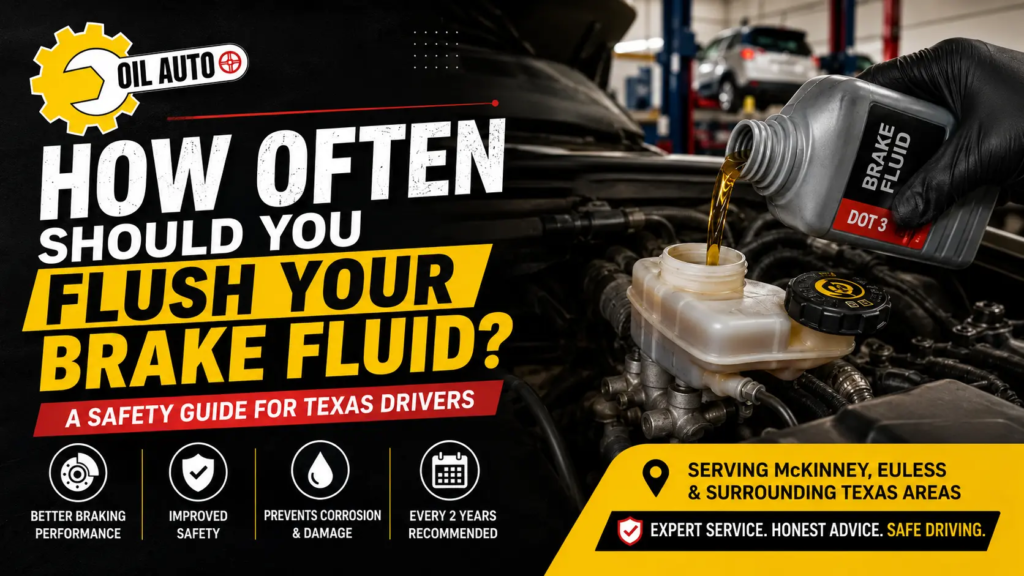
Driving through Texas means dealing with everything from scorching summer heat and stop-and-go city traffic to long highway road trips. While most drivers remember routine oil changes and tire rotations, one critical maintenance task is often overlooked brake fluid flushing.
If you’ve ever wondered how often should you flush your brake fluid, you’re asking one of the most important questions about vehicle safety. Your brake fluid plays a vital role in transferring the force from your brake pedal to the braking system. As it ages, it absorbs moisture, becomes contaminated, and gradually loses its effectiveness.
Most vehicle manufacturers recommend a brake fluid flush every 2 years or approximately every 30,000 miles, although the exact interval depends on your vehicle, driving conditions, and the manufacturer’s maintenance schedule. Because Texas drivers often face extreme heat, heavy traffic, and frequent braking, having your brake fluid inspected regularly and replaced when needed helps maintain safe braking performance and protects critical components such as the master cylinder and ABS system.
Ignoring old brake fluid doesn’t just reduce braking performance, it can increase stopping distances, damage expensive brake components, and even create dangerous driving situations.
At Oil Auto Plus, we help drivers throughout McKinney, Euless, and surrounding Texas communities keep their braking systems operating safely. Whether you need preventive maintenance or complete Brake Repair in McKinney or in Euless, understanding brake fluid maintenance is the first step toward safer driving.
Ready for service you can count on?
Our certified technicians are ready to help with everything from fast oil changes to complete auto repair.
Why Brake Fluid Is More Important Than Most Drivers Realize
Brake fluid is a specially engineered hydraulic fluid that transfers the pressure created when you press your brake pedal into stopping power at each wheel.
Unlike engine oil, brake fluid doesn’t lubricate moving engine parts. Instead, it works under extremely high hydraulic pressure and temperatures every time you slow down or stop.
The problem is that brake fluid is hygroscopic, meaning it naturally absorbs moisture from the air. Even though your braking system is sealed, tiny amounts of moisture slowly enter through hoses, seals, and the master cylinder reservoir over time.
As moisture content increases:
- Boiling point decreases
- Internal corrosion begins
- Brake pedal responsiveness suffers
- ABS components become vulnerable
- Brake performance becomes less predictable
This is why manufacturers recommend replacing brake fluid periodically rather than waiting for obvious problems.
So, How Often Should You Flush Your Brake Fluid?
The general recommendation from most vehicle manufacturers is:
Every 2 Years or Every 30,000 Miles
This recommendation has become the industry standard for passenger vehicles.
That’s why you’ll often hear technicians refer to the brake fluid flush interval 2 years rule.
However, the ideal interval depends on several factors:
1. Texas Climate
Texas heat accelerates brake system temperatures.
Long summers, high pavement temperatures, and frequent stop-and-go traffic cause brake fluid to deteriorate faster than in cooler climates.
2. Driving Conditions
Drivers who regularly experience:
- Heavy traffic
- Mountain driving
- Frequent towing
- Delivery driving
- Aggressive braking
should consider more frequent brake fluid inspections.
3. Vehicle Age
Older vehicles often develop microscopic leaks or aging rubber seals that allow moisture to enter the hydraulic system faster.
4. Manufacturer Recommendations
Luxury vehicles, European models, hybrids, and performance vehicles sometimes recommend brake fluid replacement every 20,000 miles.
Always check your owner’s manual, but if you’re unsure, professional testing provides the most accurate answer.
Why Moisture Is the Biggest Enemy of Brake Fluid
Fresh brake fluid has an exceptionally high boiling point.
As moisture accumulates, that boiling point drops significantly.
During hard braking:
- Brake temperatures rise dramatically.
- Moisture inside the fluid begins turning into steam.
- Steam compresses far more easily than hydraulic fluid.
- The brake pedal becomes soft.
- Stopping power decreases.
This dangerous condition is known as brake fade, and it can occur unexpectedly during emergency braking or long downhill driving.
For Texas drivers navigating busy highways or congested city traffic, reliable braking isn’t optional.
How to Know When Your Brake Fluid Needs Flushing
Sometimes your vehicle tells you it’s time before your maintenance schedule does.
Here are the most common warning signs.
1. Spongy Brake Pedal
One of the biggest spongy brake pedal causes is contaminated brake fluid.
If your brake pedal feels soft, sinks farther than usual, or requires extra pressure before the brakes engage, moisture or air may already be affecting hydraulic performance.
A brake fluid flush often restores pedal firmness provided no other hydraulic components are damaged.
2. Brake Fluid Has Changed Color
Fresh brake fluid is usually:
- Clear
- Light amber
- Pale yellow
Over time it becomes:
- Dark amber
- Brown
- Very dark brown
- Nearly black
Following a brake fluid color guide clear to dark brown can help identify contamination.
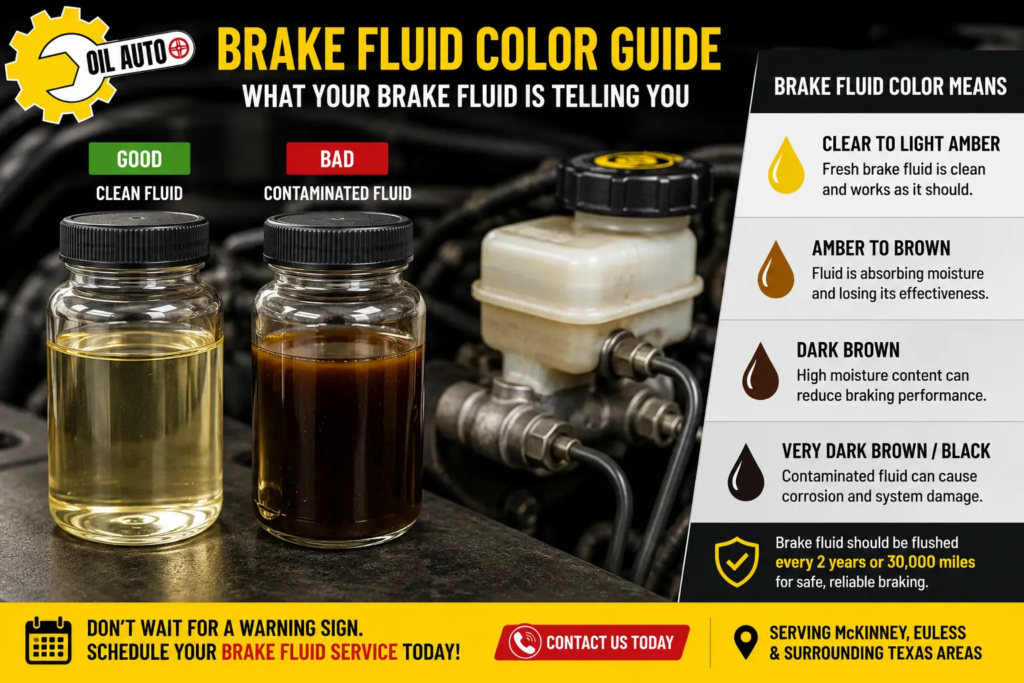
Dark fluid usually indicates:
- Moisture absorption
- Oxidation
- Rubber seal deterioration
- Internal corrosion
- Metal contamination
If your brake fluid resembles coffee instead of honey, it’s time for professional service.
3. ABS Warning Light Appears
Many drivers don’t realize there’s a connection between the ABS warning light brake fluid condition.
Low-quality or contaminated brake fluid can interfere with:
- ABS hydraulic control units
- Electronic brake pressure
- Sensor operation
- Hydraulic modulation
Although an ABS light doesn’t always mean the fluid is bad, inspecting the brake fluid should always be part of the diagnostic process.
4. Longer Stopping Distances
If your vehicle suddenly requires more distance to stop even with good brake pads, it may indicate deteriorated hydraulic performance caused by contaminated fluid.
5. Burning Smell During Heavy Braking
Brake systems operate at extremely high temperatures.
Old brake fluid cannot dissipate heat as effectively, increasing the likelihood of overheating during demanding driving.
What Happens During a Professional Brake Fluid Flush?
Many drivers assume technicians simply top off the reservoir.
That’s not a brake fluid flush.
A complete professional service includes:
- Inspecting the entire brake hydraulic system.
- Testing fluid condition and moisture content.
- Removing old contaminated brake fluid.
- Flushing fresh manufacturer-approved fluid throughout the system.
- Bleeding air from all brake lines.
- Testing brake pedal pressure.
- Verifying ABS operation when required.
- Road-testing the vehicle for proper braking performance.
Professional equipment ensures nearly all contaminated fluid is removed.
Can You Just Add New Brake Fluid?
This is one of the biggest misconceptions.
Adding fresh brake fluid to old contaminated fluid only dilutes the problem.
Moisture remains inside the system.
Corrosion continues.
Performance doesn’t fully return.
A complete hydraulic flush removes contaminated fluid from:
- Brake lines
- Calipers
- Wheel cylinders
- Master cylinder
- ABS module
Only then is the braking system restored to optimal condition.
How Much Does a Brake Fluid Flush Cost?
One of the most searched topics is brake fluid flush cost.
Pricing depends on:
- Vehicle make
- Brake fluid type
- ABS complexity
- Labor time
- Manufacturer requirements
For most passenger vehicles, brake fluid flushing is significantly less expensive than replacing:
- Brake calipers
- ABS hydraulic modules
- Master cylinders
- Brake lines
Preventive maintenance almost always costs far less than repairing corrosion damage.
At Oil Auto Plus, our technicians inspect the entire braking system to ensure you’re paying only for the services your vehicle genuinely needs.
Ready for service you can count on?
Our certified technicians are ready to help with everything from fast oil changes to complete auto repair.
Why Texas Drivers Shouldn’t Delay Brake Fluid Service
Texas driving conditions place additional stress on braking systems.
Consider what your brakes experience every year:
- Summer pavement temperatures exceeding 140°F
- Heavy interstate traffic
- Frequent construction zones
- Long suburban commutes
- Emergency highway braking
- Weekend towing and travel
These conditions accelerate brake system wear.
Routine brake fluid maintenance helps maintain consistent stopping power regardless of weather or driving conditions.
Brake Fluid Maintenance vs. Brake Pad Replacement
Many drivers confuse these services.
Brake pads wear mechanically.
Brake fluid deteriorates chemically.
You may need:
- New brake pads without a fluid flush.
- A brake fluid flush while brake pads remain in excellent condition.
- Both services simultaneously depending on inspection results.
That’s why professional brake inspections evaluate the entire braking system not just the pads.
The Growing Importance of Preventive Brake Maintenance
Modern vehicles rely on increasingly sophisticated braking technology.
Advanced Driver Assistance Systems (ADAS), electronic stability control, traction control, emergency braking assistance, and anti-lock braking systems all depend on properly functioning hydraulic brake systems.
Automotive service organizations continue emphasizing preventive maintenance because neglected brake fluid has become one of the leading contributors to premature hydraulic component failure. As vehicles become more electronically integrated, maintaining clean brake fluid isn’t just about preserving braking performance, it’s about supporting the reliable operation of multiple vehicle safety systems.
For drivers planning to keep their vehicles for many years, routine brake fluid replacement is one of the simplest ways to help protect expensive components and reduce the likelihood of unexpected repair costs.
Why Choose Oil Auto Plus?
Choosing an experienced repair facility matters just as much as performing maintenance itself.
Oil Auto Plus has built its reputation by providing honest inspections, quality workmanship, and dependable automotive care for Texas drivers.
Whether you need routine maintenance or complete auto repair services Euless, our certified technicians use professional diagnostic equipment and manufacturer-recommended procedures to help keep your vehicle operating safely.
Our services include:
- Brake inspections
- Brake fluid flushing
- Brake pad replacement
- Rotor resurfacing and replacement
- ABS diagnostics
- Complete brake system repairs
- Oil changes
- Preventive maintenance
- Multi-point vehicle inspections
With convenient locations serving McKinney, Euless, and nearby communities, we’re committed to helping drivers stay safe on every trip.
Don’t Forget Your Engine Oil
Brake maintenance is only one part of protecting your vehicle.
Regular oil changes remain one of the most effective ways to extend engine life and improve overall performance.
If your brake inspection is due, it’s often a convenient time to schedule an oil change as well.
When Should You Schedule Brake Service Immediately?
Don’t wait for your next maintenance interval if you notice any of the following:
- Soft or sinking brake pedal.
- ABS warning light illuminated.
- Dark brown or black brake fluid.
- Increased stopping distance.
- Brake fluid leaks.
- Burning smell during braking.
- Vehicle pulling while braking.
- Brake warning indicators on the dashboard.
Prompt inspection can prevent more extensive repairs and improve overall driving safety.
Final Thoughts
So, how often should you flush your brake fluid? For most drivers, every two years or approximately every 30,000 miles is a practical guideline. However, the right interval depends on your vehicle, driving habits, and local conditions. In Texas, where high temperatures and demanding traffic place additional stress on braking systems, routine inspections become even more important.
Brake fluid may not receive the same attention as engine oil or tires, but it has a direct impact on your ability to stop safely. Keeping it clean helps preserve hydraulic performance, supports critical safety systems like ABS, and reduces the risk of costly repairs caused by internal corrosion.
If you haven’t had your brake fluid inspected recently, now is a good time to include it in your next maintenance visit. Whether you need Brake Repair in McKinney or in Euless, or a complete brake system inspection, the experienced team at Oil Auto Plus is ready to help.
FAQs
How often should you flush your brake fluid?
Most manufacturers recommend replacing brake fluid every 2 years or around 30,000 miles, although the exact interval depends on your vehicle, driving conditions, and the type of brake fluid specified by the manufacturer.
What are the most common spongy brake pedal causes?
A spongy brake pedal is often caused by moisture-contaminated brake fluid, air trapped in the brake lines, hydraulic leaks, worn master cylinders, or failing brake components. A professional inspection is the best way to identify the exact cause.
What does brake fluid color indicate?
Fresh brake fluid is typically clear to light amber. As it ages, it changes to dark amber or dark brown due to moisture absorption, oxidation, and contamination. Dark brown brake fluid is generally a sign that it should be replaced.
Can low or contaminated brake fluid trigger the ABS warning light?
Yes. Although an ABS warning light can have several causes, contaminated or insufficient brake fluid can affect hydraulic pressure and ABS performance, making a brake fluid inspection an important part of the diagnostic process.
Is a brake fluid flush worth the cost?
Yes. A brake fluid flush is a relatively inexpensive preventive maintenance service that can help protect costly components such as the master cylinder, brake calipers, brake lines, and ABS hydraulic module while maintaining safe braking performance.
Ready for service you can count on?
Our certified technicians are ready to help with everything from fast oil changes to complete auto repair.